What surprised me most in researching thermal energy storage for the EBNfeature article this month is that it's not incorporated into virtually all commercial buildings. In a nutshell, the idea is to use electricity at night to make ice and then use that ice during the daytime as the cooling source for the building. Thermal energy storage (TES) can also involve chilled water (instead of ice) or electric heat stored in bricks or other thermal mass, but I focused on ice with this article.
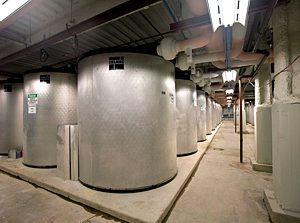
A number of very well-known green buildings rely on ice-based TES cooling. One of the newest such buildings is the 2.1-million square-foot (195,000 m2) Bank of America building in New York City at One Bryant Park. I visited the sub-basement (three floors down) to see the 44 eight-foot-diameter, insulated CALMAC tanks in the building that collectively provide about a quarter of the building's cooling. Each of these tanks holds about 1,600 gallons of water that is alternately frozen and thawed by circulating a glycol solution through about three miles of plastic tubing. It's high-tech, but the result is surprisingly simple.
Benefits of ice-based TES include the following:
Saving money by using less expensive off-peak electricity for cooling. Most utility companies offer less expensive off-peak electricity rates for commercial and industrial customers.
Saving money by reducing electric demand charges. Demand charges are based on the peak electricity consumption of a building. By shifting the operation of energy-intensive chillers or compression-cycle air conditioners from daytime (when electricity consumption in commercial buildings is highest) to nighttime, peak demand can be significantly reduced.
First-cost savings can often be achieved by downsizing chillers, pumps, ducts, and other components. In some cases, floor-to-floor height can also be reduced, because smaller ducts are used, resulting in dramatic savings.
Even though there is an efficiency loss with any heat-exchange process, a lot of the losses inherent in ice-based TES can be offset by higher efficiency that results from operating the chiller or A/C system continuously at night (eliminating the on-off cycling) and by operating the equipment with cooler nighttime air temperatures.
Reduced pollution emissions? This depends on where the building is located and how the local utility company generates power during on-peak and off-peak periods. If the baseload generation is hydropower and nuclear and peaking plants are natural gas or oil, minimizing peak electricity use can significantly reduce emissions — but with baseload coal plants and peaking hydropower or cleaner-burning natural-gas plants, the opposite can be true.
Using off-peak electricity for cooling will allow us to benefit from wind power and other renewable electricity sources. When the wind is blowing isn't always when we need power. That's fine if wind energy is only providing a few percent of our electricity, but if that fraction grows to 20% or more, it could be a problem. Shifting cooling loads to nighttime hours is an important way to help us benefit from wind power.
More detail on these benefits, plus explanations of how different types of ice-based TES systems work, is described in Buildings on Ice: Making the Case for Thermal Energy Storage. The article lists more than a dozen companies that produce these TES systems, including CALMAC Manufacturing, Baltimore Aircoil, EvapCo, and Ice Energy. All but the latter of these companies produce TES equipment that works with chillers; Ice Energy makes TES equipment for smaller, packaged A/C systems.
To access the full article, you have to be a paid subscriber to BuildingGreen.com. (Because we don't carry advertising in EBN, we have to charge for access to our information.) If you're not already a subscriber, you can either sign up for a week for $12.95 or get an annual membership for $199.
Alex Wilson is the executive editor of Environmental Building News.
TSE is really cool, pardon the pun. I've used it on several projects back in the early 1980s. Typically it increased the building's value by 5% through lower energy costs. The comment in the article about smaller ducts has more to do with using a lower air temp 44F versus 55F rather than the use of TSE itself.
However, when the utilities stopped offering rebates (often up one third of the first costs) they stopped being popular since the A&E community did not have the ability to sell the economic benefits. The TSE system as used in the One Byrant Park/ BanK America Tower is designed to shave peak demand load and rebates are coming back.
Sounds like very good common sense! T,he manufacturers of these systems could do well to get themselves over to Transport for London and talk about installing this kit in the underground railway network there that on the deeper lines is plagued with excessive heat, plenty of ground water, space to put the kit and locations above ground to put the renewable energy systems to contribute some sustainable energy to the job.





Add new comment
To post a comment, you need to register for a BuildingGreen Basic membership (free) or login to your existing profile.