LIVE image
Does prefabrication make green houses more affordable? I asked this question almost a year ago when I was working on a feature article on the topic. Back then the answer was "not quite yet." A year later, the answer still seems to be "not quite yet," at least according to Chad Ludeman, developer of the 100K house in Phildelphia, in an article on Jetson Green. Actually, Ludeman puts it more strongly: "I just don't believe it is the best way of delivering modern design to the average new home buyer," he writes. Ludeman is talking about a particular segment of prefabricated housing: the sleek modernist green homes by the likes of Michelle Kaufmann and LivingHomes. He looks at the issue from the four claims most often made in favor of prefabrication.
  • Prefab is more affordable
  • Prefab produces less waste
  • Prefab takes less time
  • Prefab is more "Green"
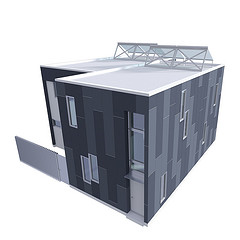
He argues that most of the modernist houses could be stick-built for less money, that over-engineering in the prefab industry makes the less waste argument specious, that long waiting lists for prefab homes make time savings irrelevant, and the green aspects of prefab are dependent on the less waste argument. Ludeman's arguments are good ones, especially as the industry stands right now. Until green features--superinsulation, benign materials and finishes, and energy- and water-efficient appliances and fixtures--become standard, prefabrication isn't going to offer many benefits over stick-built homes in terms of cost. Environmentally, the jury is still out, but the potential benefits go far beyond the waste reductions (worker transportation, site impacts, etc.). Prefabrication depends on volume to realize the benefits mentioned above. Companies producing modernist, green, or modernist-green prefabs are still small and don't have the volume to bring down material and labor per house costs. For larger companies, green features mean modifications to their stock plans, which means extra expense. Ludeman suggests a semi-custom approach with prefabricated components, an approach many production builders already use for large developments. Adjusting this approach for infill development would be a great idea. There are several companies out there that mix and match prefabricated components in custom and semi-custom structures. Unlike Ludeman, I'm not ready to give up on prefabrication just yet. I still think there's promise in the idea of prefabricated green, especially in the mainstream and affordable housing markets. As for green modernist housing, the benefits of prefabrication may never come through for such a relatively small market. Image: A rendering of the 100K house.

If you enjoyed this article, sign up for BuildingGreen email updates

*

Comments

I own a prefab home because i

I own a prefab home because in central New Hampshire, Epoch was the only builder able to give me an energy star home. Yes, it was more expensive than stick built initially but it was more solidly built (20% more wood) than a stick built home of the same square footage and that has value. We also enjoy much lower energy bills than our stick built neighbors and our home is more sound proof and those attributes have value. Having been in my home 8 years now, I consider the price difference a wash and now have bragging rights over my neighbor's energy bills. I encourage people to take the longer view of the 'cost' of these prefab homes.


Hello, I agree there is still

Hello, I agree there is still much to be said for on-site construction versus factory made house sections. Our company, Noble Home, creates affordable house kits, which are assembled/built on site by a builder or owner. With a building system and kit of parts, designs can be site specific and can be much more sustainable than a typical prefab which are generally non climate responsive. The design and kits average about $50 per square foot, but do not include interior finishes.


— Share This Posting!

Recent Discussions

posted by needcleanair
on May 17, 2013

I am a little (a lot) late to this conversation, but I think the only wood-burning appliances should be direct vent masonry ovens which burn at...

posted by ttabach
on May 16, 2013

Am hearing about this new technology and seeing positive reviews online but have also being told that they're not appropriate for larger, older...

posted by Brent Ehrlich
on May 13, 2013

Hi Patsy,

This listing is just for BlueskinVP, not Air Bloc (a fluid-applied product), which we do not list. On the landing page you have...

Recent Comments


Have Your Wood or Pellet Stove and Cleaner Air Too

Barbara A. Smith says, "

I am a little (a lot) late to this conversation, but I think the only wood-burning appliances should be direct vent masonry ovens which burn at...

" More...


The Mismeasure of Buildings: Five Reasons Life-Cycle Assessment Will Not Give Us Zero-Impact Design

Alex Bruce says, "

...

" More...


7 Tips to Get More from Mini-Split Heat Pumps in Colder Climates

Paula Melton says, "

Tanya, the guest author has shared this reply with me via email.


Hi Tanya,

I agree totally with Tristan. The first...

" More...

Tristan Roberts says, "

Hi Tanya, I'm going to punt on this question, but hopefully in a way that is helpful. There are a lot of advantages to mini-split systems, but...

" More...

Tanya Tabachnikoff says, "

I am curious about this new technology but have heard different views regarding its use for a large, not-yet-well-insulated 1860s home in Vermont...

" More...