
I had trouble finding at first, but managed to source from Dortech Direct:
http://www.dortechdirect.co.uk/WindowInstallationTools-Accessories/Backe...
Works really well. Thank you.
Blog Post
This is part of an ongoing series. Read all the Sticky Business posts here.
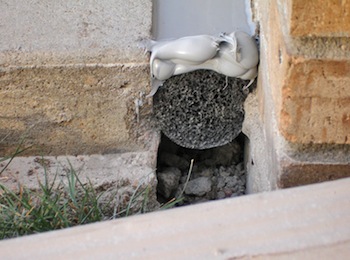 It's great they remembered the backer rod in this attempt to seal the joint, but with the depth of the sealant so skinny compared to the width, it's probably going to fail. Read on to learn why.
Continuous air and water barriers are essential to healthy and high-performing buildings, but making these barriers truly continuous is more than just slapping on some building paper. It requires meticulous detail work. Sealants—properly applied—are a key part of that.
Sealants are liquid-applied substances tooled to a concave surface shape, with “edge bonding” to each substrate. In the case of air and water barriers, they connect one field of the wall to another or to the component in the penetration—the window, the pipe stack, the duct, etc.
Essential to any sealant application is a backer rod or bond breaker tape. These ensure that:
 Conventional moving weatherseal. Image: Dow Corning Americas Technical Manual, page 56
Open-cell backer rods have the advantage of “breathing,” allowing curing to the backside of the joint, and are not affected by any puncturing that might result during tooling. By contrast, closed-cell backer rods, if punctured during tooling, can offgas and create bubbling in the sealant. Closed-cell backer rods don’t absorb water, while open-cell ones do. A third type of backer rod is the “hybrid” bi-cellular backer rod; it does not outgas when punctured and only takes up moisture at cut ends.
Use the type of backer rod recommended or required by the sealant manufacturer.
BuildingGreen relies on our premium members, not on advertisers. Help make our work possible.
See membership options »Bond breaker tapes are particularly well suited to closed joints (no gap), where the two substrates are perpendicular to each other. Omitting bond breaker tape is incredibly common in this configuration—even though it is this perpendicular, or “fillet,” configuration that places the most stress on the sealant with any joint movement.
You can’t mechanically support a sealant joint the way you can a tape or membrane; the adhesion of the sealant to the substrates alone is what you are counting on.
 The corner bond break relieves the stress on the non-compressible sealant bead. Image: Dow Corning Americas Technical Manual
There are a slew of ASTM standards to consider for liquid sealant performance. The best guidance on this comes from the National Institute of Building Science (NIBS) Whole Building Design Guide (WBDG) Web Resource Page on Joint Sealants (pdf). This document also has useful sample specification information.
Just as important, though, is performance field-testing of sealants. Dow Corning’s 2011 Technical Manual (pdf, needs email address to proceed) includes a “Standard Field Adhesion Test.” Although clearly best suited for the commercial construction context, the concept and techniques can be applied to residential construction.
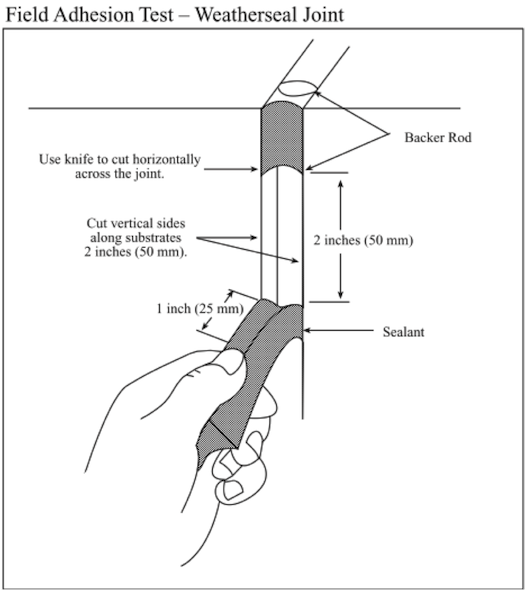 Field adhesion test. Image: Dow Corning Americas Technical Manual, page 73
NOTE: Establishing barriers at the cladding level of the building assembly is considered a “face-sealed” approach only appropriate for precipitation exposure of 20 inches annually, or less. And the appropriate approach for face-sealed, surface level barriers is the “weeped”, two-stage sealant system describe below.
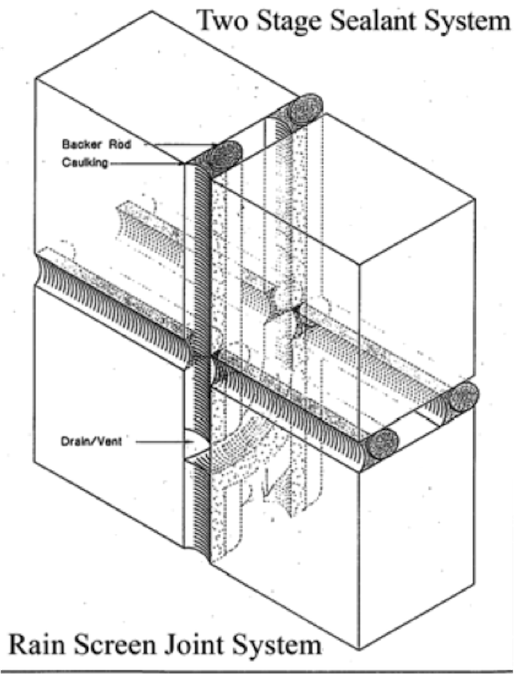 Rainscreen Joint. Image: United Professional Caulking and Restoration
Published May 9, 2012 Permalink Citation
(2012, May 9). Breaking the Bonds of Bad Sealant Jobs. Retrieved from https://www.buildinggreen.com/blog/breaking-bonds-bad-sealant-jobs

I had trouble finding at first, but managed to source from Dortech Direct:
http://www.dortechdirect.co.uk/WindowInstallationTools-Accessories/Backe...
Works really well. Thank you.
I have one question.
I'm looking at a butt type joint, but in this case the space to be caulked is formed by a rebate on one edge of one strip ant the side of the next strip. The strips themselves being epoxied to the base material. IE Although the space has three sides as in a butt joint, the caulking is only in contact with two pieces of material. Is a bond breaker necessary in this case?



Add new comment
To post a comment, you need to register for a BuildingGreen Basic membership (free) or login to your existing profile.