...or is it? Our confidence in tape might be a little misplaced.
Photo: Peter Yost Their location means that they cannot be inspected, repaired, or replaced; we need to know that they will maintain their integrity and function for the full service life of the assembly.While liquid sealants most often are used on the exposed surfaces of building enclosures, pressure-sensitive adhesive tapes and membranes are used one or even two layers deep in the building assembly to seal the margins of weather-resistive and air barriers and at penetrations such as window openings.
What makes stuff “sticky?”
It’s pretty easy to take pressure-sensitive adhesion (PSA) for granted; from band-aids to masking tape to peel-and-stick membranes, we use them pretty much every day. But the science of PSA is complex and even a bit uncertain.
We do know that certain large-chain polymers can “wet” (meaning that while they are solids, they can act like liquids when under mechanical pressure) to allow intermingling with the substrate at just about the molecular level, creating huge surface areas of contact between the PSA and the substrate. This intermingling allows small but cumulatively powerful electrostatic-like bonds to form.
These bonds are physical, not chemical (the two being distinguished by the former involving no permanent or irreversible changes to the two materials, and the latter involving both types of changes). In fact, you can stick certain PSA tapes to themselves, then go into a dark room, tear them apart, and see tiny blue sparks: these are the expression of the energy released as the physical bonds of adhesion are broken (check out this YouTube video for a cool way to have fun with duct tape).
SUPPORT INDEPENDENT SUSTAINABILITY REPORTING
BuildingGreen relies on our premium members, not on advertisers. Help make our work possible.
Sometimes we want PSA tapes to be modest and easily reversed—like a sticky note. But with PSA tapes and membranes in our building assemblies, we want that adhesion to be very strong and darn near irreversible.
We also want the tapes or membranes to be unaffected by temperature extremes, establish and maintain the adhesion in the presence of moisture, adhere to a wide variety of substrates, and tolerate the dust and dirt found on the surfaces of the building materials to which the PSA tapes and membranes will be applied.
The four basic types of PSA differ in how they meet all these properties and—not surprisingly—differ in cost as well.
Types of PSA
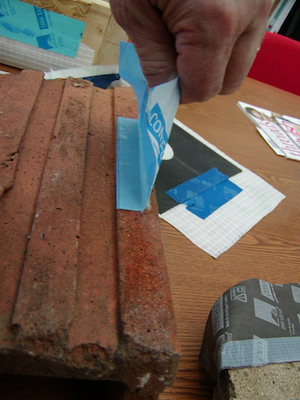
"Benchtop" testing of a Pro Clima PSA tape on a terra cotta drainage tile (using Pro Clima primer).
Photo: Peter Yost Rubberized asphalt and butyl rubber adhesives dominate in flexible membranes (generally thicker, more flexible and wider materials) and acrylic and silicone in tapes (generally less wide, somewhat less flexible and thinner materials), but this is not a hard-and-fast rule. Regardless of their properties and differences as described below, each becomes more effective and durable when properly weatherlapped and mechanically supported.There are four primary types of PSA tapes and membranes: rubberized asphalt (modified bitumen), butyl rubber, acrylic, and silicone.
Rubberized asphalt
These PSA membranes are probably most familiar as the 3-foot wide ice-and-water shield details on roof eaves (WR Grace Vycor, for example). Rubberized asphalt (RA) membranes are among the least expensive membranes and also among the most temperature-sensitive, losing significant adhesion as the temperature drops below 40º–50ºF and becoming very soft, unstable, and likely to flow at high temperatures.
RA membranes bond reasonably well to some (but certainly not all) common building materials: wood, plywood, rigid vinyl (such as window flanges), and metal. They do not bond well to OSB, and some manufacturers recommend the use of a primer for many substrates, particularly OSB.
Chris Makepeace, a prominent building scientist from Edmonton, Canada (who popularized the PERSIST air- and water-barrier system), sums up modified bitumen membranes and the need for primers this way: “If you use a primer, it’s called peel-and-stick; if you don’t, it’s called stick-and-peel.”
Butyl rubber
Butyl rubber membranes were developed to augment RA membranes because they are less temperature-sensitive and maintain their tackiness at much lower temperatures than RA membranes.
They also stick well to more substrates. Butyl rubber membranes are more expensive than RA membranes. One of the most recognizable butyl rubber membranes is DuPont’s FlexWrap, which can be used on inside corners, like window sill corners.
Both rubberized asphalt and butyl rubber membranes are “self-healing;” they conform around penetrations, nearly sealing them.
Acrylic
Acrylic adhesives can be water-based, solvent-based, or “solid.” Water-based adhesives are the least expensive of the three and generally do not bond to as wide a variety of substrates as solvent-based ones.
Solid acrylic adhesives can form the strongest adhesive bonds at a wide range of temperatures and even achieve adhesion to damp or wet substrates. Solid acrylic adhesives are also VOC-free, and the absence of any solvents means little to no embrittlement of the tapes over time.
Both water- and solvent-based acrylics are cost-competitive with butyl rubber PSA tapes; the solid acrylic PSA tapes come with an additional premium.
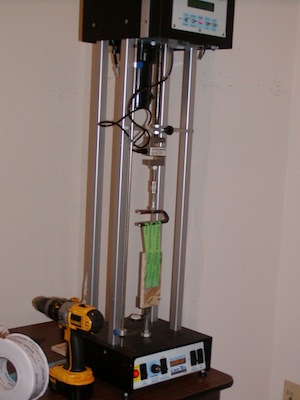
Tensile testing of a SIGA PSA tape on the smooth side of OSB, using a Com-Ten DFM5000 tester.
Photo: Peter Yost The amount of adhesive per unit area of tape can also be a factor in the initial and long-term PSA tape performance; more adhesive can mean more robust performance, especially if a substrate is less than squeaky clean.Two other important aspects of PSA tape performance are the type of backing material and the amount of adhesive. The backing material can contribute to the overall durability of PSA tapes and determine the vapor permeability of the tape, (of particular importance in cold climates, where moisture accumulating under the PSA tape or membrane can freeze and degrade long-term adhesion).
Installation & testing are key
Each of the above types of adhesives may need the addition of a primer to achieve a quality bond to certain substrates, such as concrete or OSB. And some tapes adhere much better to one side of the OSB over the other (most OSB has a “screened” side and a burnished side (the structural stamp is almost always on the slippery, burnished side).
The best way to select the type of PSA tape or membrane is to try it in the environment and on the substrate(s) in your assembly. Since I am right in the middle of some “benchtop” adhesion tests for a wide variety of common PSA construction tapes and membranes, I will come back soon with some of my own recommendations for PSA tapes and membranes. Until then, watch for another post on how to judge—and increase—the longevity of sealants and tapes.
Yost, P. (2012, July 10). Stickiness Explained! Making Building Tapes and Membranes Stay Put. Retrieved from https://www.buildinggreen.com/blog/stickiness-explained-making-building-tapes-and-membranes-stay-put
you can imagine that a tarcoated substrate is going to be as tough substrate to adhere to.
I think your best bet is to be a bit of a wingnut and do some of your own tape testing. I would start with an agressive acrlyic PSA, such as Huber ZIP tape.
Hi, I am looking for the best tape that adheres to tar coated OSB substrate surface for a roofing project. Temperatures range from 25C to -5C. Very dry weather in the Summer. Rainly season lasts 5 months





Add new comment
To post a comment, you need to register for a BuildingGreen Basic membership (free) or login to your existing profile.