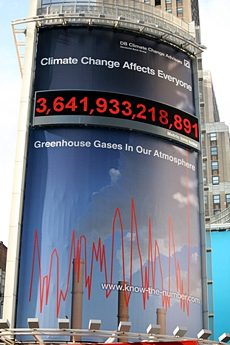
This morning, at 33rd St and 7th Ave in the middle of New York City — right outside of Madison Square Garden and Penn Station — a 70-foot-tall digital billboard displaying a real-time running total of atmospheric greenouse gases was unveiled. The display reflects a measurement of 24 long-lived greenhouse gases (not including ozone and aerosols) named in the Kyoto and Montreal Protocols, and is based on Massachusetts Institute of Technology (MIT) research. The Carbon Counter is part of a "Know the Number" awareness and education campaign by Deutsche Bank's institutional climate change investment and research business, the DB Climate Change Advisors group (DBCCA).
In a press release, MIT Professor of Atmospheric Science Ronald Prinn is quote as saying:
"It is useful to have an up-to-date estimate of a single integrating number expressing the trends in the long-lived greenhouse gases contributing to that change. This number can help convey how fast these greenhouse gases are increasing, and the progress, or lack thereof, in slowing the rate of increase. The number on the Counter is based on global measurements. It shows the total estimated tonnage of these gases expressed as their equivalent amounts of carbon dioxide, with seasonal and other natural cyclical variations removed to more clearly reveal the underlying long term trends driven by human and other activity."
The carbon footprint of the billboard, which includes nearly 41,000 LEDs, is offset using carbon credits.
As a company, Deutsche Bank is working to reduce its carbon emissions annually by 20%, with a goal of carbon-neutrality from 2013. Carbon credits? RECs? It's still noteworthy and praiseworthy. How does your company compare?
The Carbon Counter Number is also available anytime at www.know-the-number.com — or right on your own computer via a free downloadable widget.
This is a really interesting venture, especially coming from a commercial entity! I'm curious about how their decision to promote a number based on tons of carbon equivalent might affect Bill McKibben's effort to bring everyone together around the goal of 350 ppm carbon.
It would be nice to at least have a ready translator between the two. Is there any way to say what concentration in ppm the know-the-number number represents?
DBCCA, the know-the-number host, discusses their expression of the relationship between ppm, CO2e, and metric tonnage: "Greenhouse gas concentrations are frequently expressed as an equivalent amount of Carbon Dioxide (CO2). This CO2-equivalent concentration in parts per million (ppm) can then be expressed in terms of metric ton of CO2, a standard of measurement, which as a stock of gases in the atmosphere is readily understood. According to the IPCC AR4 Synthesis Report, atmospheric CO2 concentrations were 379 ppm in 2005. The estimate of total CO2-eq concentration in 2005 for all long-lived GHGs is about 455ppm. On June 18th as the counter started, long-lived GHGs in the atmosphere were estimated to be 3.64 trillion metric tons, growing at 2 billion metric tons per month, or 467 ppm, of which CO2 was 385 ppm." http://www.dbcca.com/dbcca/EN/carbon-counter.jsp
Which isn't a ready translator, but a sort of an understanding.
A good carbon-equivalent number is a trick I can't perform, what with the various gases have different global warming potentials, different atmospheric lifetimes, and individually fluctuating concentrations. ORNL's Carbon Dioxide Information Analysis Center has a chart from December '08 (and may have newer data somewhere else that I didn't turn up) showing atmospheric concentrations of various greenhouse gases in ppm, ppb, and ppt - http://cdiac.ornl.gov/pns/current_ghg.html - CO2 (by itself, not as an equivalency expression) was at 383.9 at the time; 350.org reports it as 387 currently; as noted above, know-the-number has it at 385.
Putting that information out there for the public to see is the best idea, and of course Times Square is the perfect place to show it. Can these types of signs be in every major city?





Add new comment
To post a comment, you need to register for a BuildingGreen Basic membership (free) or login to your existing profile.